

Aircraft manufacturer Airbus describes the A220 as purpose-built for efficiency. It is a small, single-aisle aircraft that seats between 100-160 passengers in a bright and comfortable cabin. The seats are wider and offer more personal space, so it is also popular with passengers. Why does the Airbus A220 have such a loyal pilot following? Let’s find out in this guide.
The Airbus A220 has new-generation engines that offer superior efficiency, with 25% lower fuel burn, CO2 emissions, and noise. It uses advanced materials, the latest technology, and state-of-the-art aerodynamics. There are two variants of the Airbus A220 — the A220-100 and the A220-300. The aircraft is a fusion of performance and technology that reduces its environmental footprint.
In The Airspace Cabin
Credit: Airbus
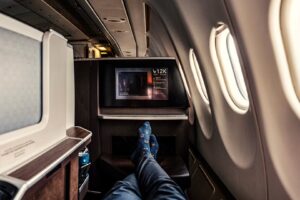
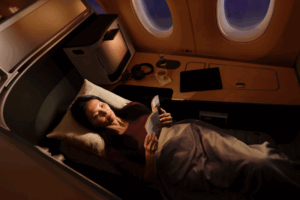
The cabin is large and airy compared to a similar-sized aircraft, and the configuration is either 3-2 or 2-2 premium seating. The seats are ergonomic, slim-lined, and wider than the comparable Airbus A320 or Boeing 737 seats, with more legroom. The overhead lockers are 60% larger than usual, and this speeds up boarding and turnaround times and allows passengers to have their baggage close by during the flight.
The new Airbus Airspace cabin is used on both types and offers superior passenger comfort. The Airspace cabin was designed to enhance the passenger experience in its modern aircraft family and prioritizes comfort and design. The sidewalls were redesigned to make it more spacious. Airbus’s Airspace cabin is a concept designed to improve passenger comfort, space, and brand consistency across its modern aircraft family, including the A350, A320neo, A330neo, and A220.
There are integrated state-of-the-art inflight entertainment systems and high-speed connectivity. Air quality has improved, and the cabin is quieter and has better pressurization. Panoramic windows flood the cabin with light, and there is customizable LED mood lighting for ambiance and to reduce jet lag. The lavatories have also been upgraded to be touchless and with antimicrobial surfaces.
A Little Background
Credit: Airbus
Before it was launched as the Airbus A220, it was the Bombardier CSeries jetliner that was launched in 2008. Bombardier had success with its previous Canadair Regional Jet (CRJ) but wanted to develop the CSeries further. The original aim of the aircraft was to fill the 100–150-seat market and be a quiet, fuel-efficient regional jet. They also had success with their Learjet, Challenger, and Global business jets. They hoped that this new aircraft would replace the Boeing 717, the Boeing 737NG, the Airbus A320, and the Embraer E190.
The project, along with delays on train orders and design issues with their business jet program, left Bombardier with financial and commercial difficulties. Sales of the CSeries were slow, so Airbus, which already held a stake in the company, acquired the CSeries program and the Bombardier facility at Mirabel, Quebec. Bombardier exited the commercial aviation industry and the trains to further concentrate on business jets. They had also had a dispute with Boeing in the process.
The CSeries was rebranded in 2018 by Airbus with the official A220 name and became part of the Airbus family. At this time, Airbus had a 50.01% stake in the company and took full control in 2020. The Airbus A220-100 (formerly the CS100) first entered service in July 2016, with Swiss International Airlines, while the A220-300 (formerly the CS300) entered service with airBaltic in December of the same year.
Related
Will Airbus Build The A220-500?
Airbus already operates several variants in its A220 series.
Why Airlines Like The Airbus A220
Credit: Airbus
The Airbus A220-100 has a range of 3,600 nautical miles and can seat 135 passengers. The slightly larger A220-300 has a 3,400 nautical mile range and has a slightly longer fuselage that can seat up to 160 passengers. It can be used for regional flights or on short to medium-haul routes, and it can be used on short runways and regional airports with ease. It can fly a variety of missions, including challenging airports like London City Airport. Furthermore, it is the only aircraft in production in its class that can perform steep approaches and long-haul routes.
Airlines can offer a wide range of routes using this aircraft, as it has the same range as larger single-aisle aircraft. Airlines can more easily change their schedules to meet demand and operate new routes without the risks normally involved. They can also operate the aircraft when fuel prices are volatile, which improves things economically. The Airbus A220 has 25% lower operating costs per seat than previous-generation aircraft.
The aircraft is more fuel-efficient, further reducing operating costs. It is a versatile and profitable aircraft for the airlines. It maximizes profitability, is lean, economical, and efficient with significant savings for operators. There is also 99% commonality on the Airbus A220 type. Therefore, less training is needed and there are fewer maintenance costs when operating this variant. However, it is not compatible with the Airbus A320, for example, and needs a different type rating.
The Technical Bit
Credit: Airbus
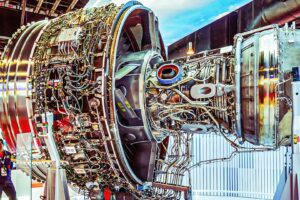
The Airbus A220 is built using lightweight materials, which also make it more fuel-efficient. The wings are made of a carbon composite material, and the fuselage is made of aluminum-lithium. These materials also allow for a longer service life. The aircraft has Pratt and Whitney PW1500G geared turbofan engines that produce 23,300 pounds of thrust. The benefit is 16% better fuel efficiency and 50% less noise, as well as optimized performance and enhanced reliability.
The A220 is fitted with the Rockwell Collins Pro Line Fusion avionics suite. It has five 15.1-inch touchscreen displays and an advanced Flight Management System (FMS). There is a Synthetic Vision System (SVS) with an optional Head Up Display (HUD). It uses fly-by-wire technology with side stick controls and, overall, reduces pilot workload. The cockpit has Airbus A350-style displays and electronic checklists that simplify procedures. Hand flying is smooth and precise. The aircraft’s fly-by-wire, control laws, human factor-centered design, and ergonomics have contributed to making the Airbus A220 a game changer.
Aircraft Specifications:
Specifications
A220-100
A220-300
Length
114 feet 9 in
127 feet
Wingspan
115 feet 1 in
115 feet 1 in
MTOW
140.5 lb x 1000
156.3 lb x 1000
Range
3,600 nm
3,400 nm
Passengers
100-120
130-160
Engines x 2
PW1500G
PW1500G
Data from Airbus
A larger Airbus A220-500 was rumored, but Airbus has not put the aircraft into production yet. It would be a stretched version of the A220-100 and would accommodate up to 180 passengers. It would fill the gap between the A220-300 and the A320neo. The aircraft would run on Sustainable Aviation Fuel (SAF), reducing its carbon footprint, and could be a future key player in sustainable aviation. Instead, Airbus is scaling up production of the existing A220s.
Related
Why Might The World’s Game-Changing Single-Aisle Aircraft Have Boeing Worried?
In this article, discover how Airbus has designed the A220 to dominate its competition, along with the challenges it faces.
Which Airlines Utilize The Airbus A220?
Credit: Airbus
There are currently 455 Airbus A220s in operation, with 21 commercial airlines. They have flown over one billion kilometers, carrying over 90 million passengers on over 1,100 routes, according to Airbus. Over 70% of the Airbus A220s will fly alongside the Airbus A320 at airlines such as Delta Air Lines, JetBlue, Air France, and Air Canada, as well as SWISS and Qantas.
Delta Air Lines is the largest operator of the Airbus A220 in North America, according to data from ch-aviation. The airline uses both variants on domestic and transcontinental routes with two classes of seating. The airline has another 65 A220-300s on order and uses the aircraft to feed its hubs. Air Canada currently has 39 A220-300s and JetBlue has 55 of the aircraft. Breeze Airways has 46 of the larger variant and uses the aircraft for point-to-point flights.
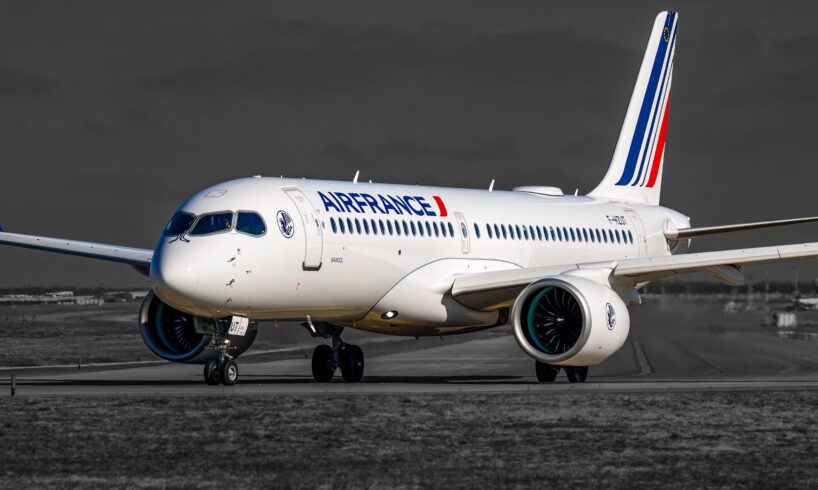
In the top five are airBaltic with 50 Airbus A220 operating regional routes within Europe. Air France has 48 A220s in operation on short and medium-haul routes and has more of the aircraft on order. The Airbus A220 replaces its older Airbus A318 and A319. The launch customer, SWISS, has 30 of the aircraft. EgyptAir scrapped one of its fleet in 2025 and sold the rest in 2024, citing that they were difficult and costly to maintain.
What The Airlines Say
Credit: Airbus
Here is what some of the airlines have said about the Airbus A220 as per this Airbus case study:
“The Airbus A220-300 provides both greater capacity and longer range. Notably, the longer range of the aircraft has enabled airBaltic to launch direct flights to destinations such as Abu Dhabi, Almaty, Malaga and Lisbon.” – Andris Vaivods, airBaltic SVP Technical Operations
“With this aircraft, we’re able to operate on longer routes, such as Moscow, Cairo or Hurghada, as well as at operationally challenging airports with short and narrow runways and complex approaches, such as London City and Florence. At the same time, the A220 is an all-rounder that can be used for all our other short and medium-haul destinations.” – Peter Koch, SWISS A220 Fleet Chief
“In the current reduced demand environment, it’s important to leverage the most efficient aircraft in the fleet. The A220 helped us fill a gap in terms of capacity between regional aircrafts and larger narrow-body aircraft, for which, the break-even threshold is too high in the current context.” – Mark Garlardo, SVP Network Planning and Revenue Management at Air Canada