
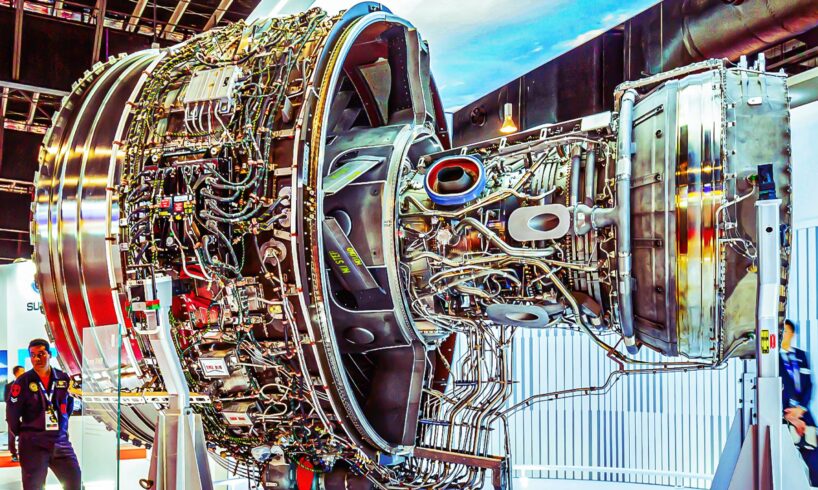
Rolls-Royce is one of the world’s leading commercial aircraft engine manufacturers, with over 13,000 engines currently in service worldwide. The British manufacturer has produced some of the most powerful and fuel-efficient aircraft engines in history, including the popular Trent series, which continues to set new standards in performance, reliability, and long-range efficiency across modern widebody fleets.
In this article, we will take a look at the five most powerful commercial aircraft engines produced by Rolls-Royce. This will see us explore their specifications, the aircraft that use them, and how each engine has contributed to advancing modern aircraft performance.
Rolls-Royce: A Brief History
Credit: Wikimedia Commons
Rolls-Royce is a British engineering company best known for making luxury cars and aircraft engines. Its roots date back to 1904, when Charles Rolls and Henry Royce first joined forces and began producing cars for the luxury market. Over time, Rolls-Royce branched into aviation, and started developing aircraft engines in the 1940s.
The first engine in Rolls-Royce’s successful Trent family, the Trent 700, entered commercial service on the Airbus A330 in 1995. Since then, the Trent series has become closely associated with advanced engineering, high reliability, and continued improvements in fuel efficiency.
Today, Rolls-Royce is one of the four major commercial aircraft engine manufacturers worldwide, along with General Electric, CFM, and Pratt & Whitney. The manufacturer employs around 50,000 people globally and has annual revenue in excess of £18.9 billion. Its engines can be found on many different types of aircraft, from large commercial aircraft like the Airbus A380 to advanced military aircraft.
You might also like:
Rolls-Royce Vs. Pratt & Whitney: Vs. General Electric: Who Dominates The Commercial Aircraft Engine Market?
Who is the world’s leading enginemaker in 2025?
Trent XWB-97 (97,000 lbf)
Credit: Airbus
The Rolls-Royce Trent XWB-97 is one of the most advanced large turbofan engines flying today, designed to power the Airbus A350-1000. Developed as the higher-thrust member of the Trent XWB family, the Trent XWB-97 builds on the design of the earlier Trent XWB-84, while introducing a number of upgrades aimed at delivering more power, improved cooling, and greater reliability.
Rolls-Royce began development in the early 2010s, responding to Airbus’s need for a more capable engine as the A350 program expanded to include the stretched, heavier A350-1000. At the heart of the Rolls-Royce Trent XWB-97 is a three-shaft design, which is typical of the Trent series. The engine features a larger fan, reinforced compressor stages, and a new turbine design capable of handling higher temperatures.
Rolls-Royce also introduced strengthened materials and an enhanced engine core to support the increased thrust capability of up to 97,000 lbf. Despite the greater power output, the Trent XWB-97 maintains the fuel efficiency and low noise characteristics that the A350 program emphasizes. The Rolls-Royce Trent XWB-97 is used exclusively on the Airbus A350-1000, the largest and most powerful variant of the A350 family. Airlines such as Qatar Airways, Cathay Pacific, and Virgin Atlantic operate the aircraft on long-haul routes where efficiency and reliability are essential.
Ranking
Airline
Airbus A350-1000
1
Qatar Airways
24
2
British Airways
18
3
Cathay Pacific
18
4
Virgin Atlantic
12
5
Japan Airlines
10
The engine’s performance allows the A350-1000 to carry more passengers and cargo while retaining the extended ranges that make the A350 line competitive with other next-generation wide-body aircraft. Qantas will soon also make use of the Rolls-Royce Trent XWB-97 engine when its first Airbus A350-1000s enter commercial service.
These aircraft will be deployed on the oneworld carrier’s upcoming Project Sunrise routes that will connect Australia non-stop with key destinations across Europe and North America, for which the Trent XWB-97’s power and efficiency will be crucial. The world’s largest operators of the Airbus A350-1000 are outlined in the table above, using the latest data from ch-aviation.
Trent 800 (95,000 lbf)
Credit: Shutterstock
The Rolls-Royce Trent 800 is one of the engines that helped define the long-haul, twin-engine era of the 1990s and early 2000s. Developed specifically for the Boeing 777, it became one of the three original engine options for the aircraft, alongside the General Electric GE90 and the Pratt & Whitney PW4000. Rolls-Royce began work on the Trent 800 in the early 1990s, adapting the basic three-shaft Trent architecture that had debuted on the Trent 700 for the Airbus A330.
Its goal was to create a lighter, more efficient wide-body engine capable of delivering the high thrust levels needed for the new twin-engine 777 family. The Rolls-Royce Trent 800 produces up to 95,000 lbf of thrust, depending on the variant, and its three-shaft layout allows each spool to operate at its optimal speed, improving both responsiveness and fuel efficiency. The engine features a large, wide-chord fan and advanced high-pressure turbine materials.
These aspects help reduce weight and enhance performance. Rolls-Royce also incorporated modular construction, making maintenance easier and lowering lifecycle costs. The Rolls-Royce Trent 800 became a popular choice on early Boeing 777-200s and 777-200ERs, with carriers such as Cathay Pacific, British Airways, and Singapore Airlines relying on it for their long-haul operations.
Although later versions of the 777 shifted toward the General Electric GE90 as the standard engine option, the Trent 800 maintained a strong presence in the global fleet for many years thanks to its reliability, good fuel burn, and smooth operation. Newer engines have since taken center stage, but the Trent 800 remains an important chapter in the evolution of modern twin-engine long-haul aviation.
You might also like:
These Are The Most Powerful Commercial Aircraft Engines Today
The world’s most powerful commercial aircraft engine has up to 134,000 lbs of thrust.
Trent XWB-84 (84,000 lbf)
Credit: Adelade Airport
The Rolls-Royce Trent XWB-84 is the original engine of the Trent XWB family and was developed specifically to power the Airbus A350-900, delivering a new level of fuel efficiency and reliability for long-haul, twin-engine operations. As part of the Trent series, the Trent XWB-84 uses Rolls-Royce’s signature three-shaft design, which allows each spool to run at its most efficient speed. This contributes to smoother operation, quicker response, and strong fuel burn performance.
Producing up to 84,000 lbf of thrust, the Rolls-Royce Trent XWB-84 features a large, 118-inch fan, advanced composite materials, and a highly efficient core optimized for long-haul flights. Rolls-Royce incorporated new turbine cooling technologies, low-emission combustors, and lightweight structures to help the engine achieve some of the best fuel efficiency figures of any large turbofan in service.
The Airbus A350-900 is the exclusive aircraft type for the Rolls-Royce Trent XWB-84. Airlines like Qatar Airways, Cathay Pacific, and Delta Air Lines deploy their A350-900s on routes ranging from regional flights to some of the longest non-stop services in the world.
Singapore Airlines also uses the Trent XWB-84 on its specially configured A350-900ULRs that operate the world’s longest non-stop commercial flight. This operates between Singapore Changi Airport (SIN) and New York John F. Kennedy International Airport (JFK).
Trent 900 (84,000 lbf)
Credit: Wikimedia Commons
The Rolls-Royce Trent 900 is one of the three engine options developed for the Airbus A380 and was the first Trent model designed specifically for a very-large, four-engine aircraft. Building on the technology of earlier Trent engines, Rolls-Royce began development in the late 1990s to meet the mighty A380’s requirements for high thrust, low noise, and strong fuel efficiency. The Rolls-Royce Trent 900 is capable of producing up to 76,000 lbf of thrust.
It incorporates wide-chord fan blades, advanced turbine cooling, and low-emission combustor technology, and its large bypass ratio and modern acoustic treatments help reduce overall noise, which is an important factor for the A380’s operation at major international airports such as London Heathrow Airport (LHR). Other airports around the world that see a significant number of A380 services include Singapore Changi Airport and Dubai International Airport (DXB).
Although the COVID-19 pandemic saw the end of the A380 at several airlines, the aircraft still plays a key role in the fleet of carriers such as Qantas, Singapore Airlines, Qatar Airways, and Emirates. The latter, based at Dubai International Airport, is the world’s largest operator of the A380, with a staggering 116 in its fleet. Many of these are being retrofitted to feature the carrier’s latest onboard cabins, including the carrier’s award-winning premium economy cabin.
You might also like:
7 Most Comfortable Airbus A380 Economy Seats You Can Book Today
Find out which A380 economy experience is known for its exceptional attention to detail.
Trent 500 (61,000 lbf)
Credit: Wikimedia Commons
The Rolls-Royce Trent 500 was developed specifically for the Airbus A340-500 and A340-600, becoming the sole engine option for these two aircraft types, which are the largest variants of the Airbus A340 family. The Trent 500 took the design of the earlier Trent 700 and combined it with scaled components and new materials to create an engine optimized for four-engine, long-haul operations.
The Rolls-Royce Trent 500 uses the classic three-shaft Trent layout, allowing each spool to rotate at its most efficient speed, producing up to 61,000 lbf of thrust. This design improves responsiveness and contributes to smoother, quieter operation.
Ranking
Engine
Maximum Thrust
1
Rolls-Royce Trent XWB-97
97,000 lbf
2
Rolls-Royce Trent 800
95,000 lbf
3
Rolls-Royce Trent XWB-84
84,000 lbf
4
Rolls-Royce Trent 900
84,000 lbf
5
Rolls-Royce Trent 500
61,000 lbf
Although not as powerful as later Trent variants, it offers strong fuel efficiency for its thrust class. The design was tailored to meet the range and payload requirements of the Airbus A340-500 and A340-600 at airlines such as Singapore Airlines and Virgin Atlantic.