
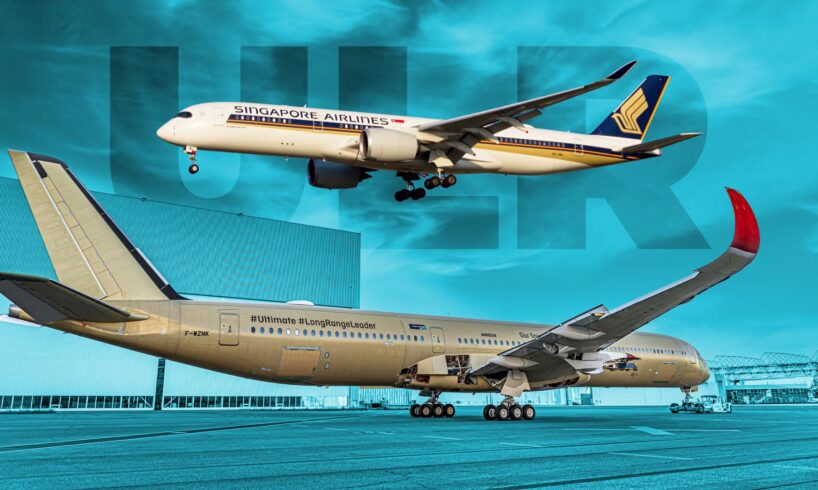
Airbus developed ultra-long-range (ULR) variants of the A350 family primarily in response to specific airline demand for economically viable, non-stop flights on the world’s longest routes, while also aiming to compete with Boeing in the long-haul market. The catalyst for the A350-900ULR was the A350 XWB program, a clean-sheet design that promised significant efficiency gains. The ULR variants were designed to compete directly with Boeing’s 777-200LR and the upcoming 777X family.
The A350-900ULR was developed specifically for Singapore Airlines to re-establish non-stop routes from Singapore to New York and Los Angeles. These plans were previously uneconomical due to using older, four-engine aircraft like the A340-500. The forthcoming A350-1000ULR is being created for Qantas’ ‘Project Sunrise’ flights, connecting Sydney and Melbourne nonstop to London and New York.
The First A350 ULR
Credit: Airbus
The story of the Airbus A350-900ULR is primarily a tale of Singapore Airlines’ ambition to re-establish and profitably operate the world’s longest commercial flights, which had previously been canceled due to the poor economics of older aircraft. In 2004, Singapore Airlines launched non-stop services from Singapore to Newark (and later Los Angeles) using the four-engine Airbus A340-500.
Singapore Airlines, already a major customer for the standard A350-900, worked closely with Airbus to develop the specialized variant, before becoming the sole operator of this specialized sub-fleet of seven A350-900ULRs. The Singapore-Newark service (SQ21/SQ22) re-launched in October 2018, and later to JFK, successfully reclaiming the title of the world’s longest commercial flight.
The airline configured the cabin in an all-premium layout with just 161 seats (67 business class and 94 premium economy) to maximize passenger comfort over flights lasting up to 20 hours. There is no economy class on the ULR jets, a decision based on both weight reduction and the understanding that most travelers would not want to spend that long in a standard economy seat.
Inside The Ultra Long Range Widebody
Credit: Airbus
While a technical marvel at the time, the A340-500 was a ‘gas guzzler’ and very expensive to operate, especially as fuel prices rose. The airline eventually had to suspend these routes in 2013. The A350’s design, which incorporates over 70% advanced materials (including carbon-fiber composites) and fuel-efficient Rolls-Royce Trent XWB engines, offers a significant 25% reduction in fuel burn and CO₂ emissions compared to previous-generation widebodies.
Airbus engineered the ULR variant as an evolution of the standard A350-900, avoiding complex structural overhauls that would have required a separate type rating. The aircraft’s Maximum Takeoff Weight was raised to 280 tons to accommodate the extra fuel load. The existing fuel system was adapted to hold an additional 24,000 liters (around 6,300 gallons) of fuel within the existing center wing box, increasing total capacity to 165,000 liters.
The A350-900ULR incorporated extended winglets, a feature that was later made available on all new A350-900s, to enhance aerodynamic efficiency. To compensate for the added weight of the fuel and accommodate a useful payload, non-essential features like the forward cargo hold and a potable/waste water tank were removed.
Related
Airbus A350 Vs Boeing 787: How Do They Compare On Ultra-Long-Haul Flights?
The A350 and Boeing 787 serve some of the world’s ultra-long-haul flights and complement each other in many airlines.
Project Sunrise
Credit: Airbus
The Airbus A350-1000ULR is a forthcoming, specially modified variant being developed for Qantas Airways to under its ambitious ‘Project Sunrise’ initiative. This aircraft will have a range of approximately 9,700 nautical miles (17,964 km), and will connect Australia’s east coast cities (Sydney and Melbourne) non-stop to major global hubs like London and New York. The first A350-1000ULR entered the final assembly line in late 2025 and is scheduled for delivery to Qantas in late 2026.
Commercial Project Sunrise services are expected to begin in the first half of 2027. To achieve the necessary range for flights lasting up to 22 hours, the aircraft has a few key modifications from the standard A350-1000. The main change is the inclusion of an additional 20,000-liter (around 5,283 gallons) fuel tank in the rear center fuselage. The aircraft will have a new maximum take-off weight of 322 tons.
Qantas is focusing heavily on passenger comfort for these marathon flights. The aircraft will feature a low-density, premium-focused layout with only 238 seats across four classes. For comparison, a typical A350-1000 can seat over 300 passengers. The layout is expected to have six private first class suites, 52 business class suites with sliding doors, 40 premium economy recliners, and 140 economy class seats.
The ‘Airspace’ Cabin Makes A Difference
Credit: Airbus
The A350 features a wider, quieter ‘Airspace’ cabin with higher ceilings, optimized cabin altitude, and improved humidity levels, which help reduce jet lag and fatigue. This focus on the passenger experience is a major selling point for airlines operating these demanding routes. The special Qantas A350 will even have a dedicated ‘Wellbeing Zone’ in between the premium economy and economy cabins, where any passenger can go to stretch, hydrate, and exercise.
The Airbus A350’s ‘Airspace’ cabin is engineered to counteract the common discomforts of long-haul travel. It makes ultra-long-range flights feel less fatiguing in terms of physiological and psychological conditions, thanks to its technology and design. The A350 maintains a cabin pressure altitude of around 6,000 feet, compared to the typical 8,000 feet of older aircraft. Using composite fuselage material means the cabin air systems can maintain a higher humidity level of around 20-25%.
The cabin air is entirely refreshed every two to three minutes using High-Efficiency Particulate Air (HEPA) filters, and the air conditioning was redesigned to be quieter than legacy aircraft as well. Advanced acoustic insulation, a refined aerodynamic design, and the Rolls-Royce Trent XWB engines work in concert to significantly reduce cabin noise. The cabin features full LED ambient for dynamic lighting scenarios to simulate natural sunrise, sunset, and daylight transitions.
This helps passengers adjust their internal body clocks and reduce the effects of jet lag. The A350 also has the widest cabin in its class and the highest ceilings, up to 8 feet in some sections. Its vertical sidewalls maximize shoulder space to create a sense of openness and reduce claustrophobia. These combined elements make the physical and mental toll on the passenger noticeably less tiring, making ultra-long-haul service appealing to flyers.
you may like
Do The Airbus A350-900 & -1000 Have The Same Engines?
The engines of the A350-900 and -1000 are visually indistinguishable but are one of several notable differences between the two variants.
Are More ULRs Coming?
Credit: Airbus
Other airlines have shown interest in the Airbus A350’s long-range capabilities, though specific ULR variants have only been ordered by Singapore Airlines and Qantas for highly specific missions. While no other airline uses the specialized ULR sub-variants, many carriers fly standard A350s on long-haul routes approaching ULR distances. For instance, Philippine Airlines flies the A350-900 on non-stop flights from Manila to New York and Toronto.
Delta Air Lines also flies the A350-900, with its longest itinerary being from Atlanta to Johannesburg. Qatar Airways prefers the A350-1000 with service between Doha and Los Angeles, while Cathay Pacific flies the A350-1000 between Hong Kong and Dallas/Fort Worth. Other airlines have not widely pursued the Airbus A350 ULR variants primarily because they serve a highly niche market of extreme-range routes.
Most carriers find the standard A350 or competitor aircraft like the Boeing 787 and 777 a better fit for their network strategies. Airlines continue to order the 787 and 777X despite Boeing’s recent issues owing to fleet commonality, operational needs, and the technical performance of the aircraft.
The US ‘Big Three’ legacy carriers (American, Delta, and United Airlines) have not ordered the 777X and have opted for other widebodies due to differences in their business models and fleet strategies compared to foreign carriers. The 777X, designed as a 747 replacement, is ideal for high-capacity, hub-and-spoke operations like Emirates. In contrast, US airlines operate lower concentration, dispersed network models, but not far enough apart to warrant any A350 ULR variants.
another good read
How Many 777Xs Has Boeing Already Started Building?
Boeing’s 777X program faces delays and challenges, but how many aircraft have they built so far?
Boeing’s Competing Models
Credit: Airbus
Boeing’s competition for the A350 ULR’s market segment is represented by the 787 Dreamliner and the upcoming 777X family. The 787 is a smaller but highly efficient widebody that can operate similar very long routes. The as-of-yet uncertified 777X will take the crown for longest range airliner once it finally debuts, but, for now, the Boeing 787 Dreamliner is more popular than the A350 in terms of total aircraft orders and deliveries to date.
Boeing’s 787 entered commercial service about four years earlier than the A350, giving it a head start in accumulating orders and deliveries. The 787-9 is the longest-range variant, capable of flying 8,000 nautical miles. Qantas currently uses the 787-9 for its Perth-London route.
In terms of total orders, the Boeing 777X is more popular than the Airbus A350-1000. It also wins on range, as the former series’ smaller 777-8 is advertised as having an 8,690 nautical mile range, beating out the standard A350-1000. The Boeing 777X family has secured over 500 orders, with the majority being for the larger 777-9X variant, whereas the A350-1000 has around 360 orders.
The 787 has three variants that target a wider range of long and thin routes that can’t support the A350’s higher capacity. Meanwhile, the 777X’s orders are concentrated among a smaller number of large carriers, such as Emirates, Qatar Airways, and Singapore Airlines, who need its higher capacity for high-density routes.