
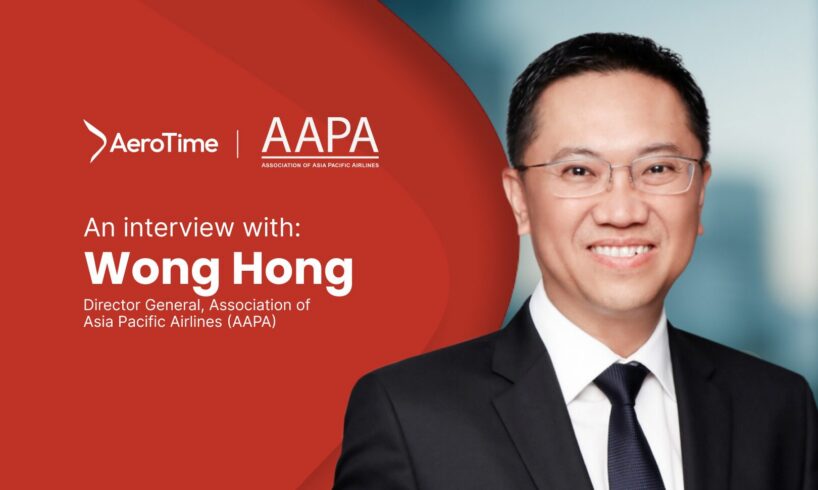
The Association of Asia Pacific Airlines (AAPA) represents the interests of carriers in what, according to most industry forecasts, is poised to become the world’s largest air travel market.
However, this isa truly vast region, which stretches all the way from Central Asia in the west to New Zealand in the east. As a result, AAPA’s membership is truly diverse. As of June 2026, its 18 member airlines include prominent carriers with global reach, such as Japan Airlines, Air New Zealand, Qantas, Singapore Airlines, Malaysia Airlines, Cathay Pacific, Air India, and Air Astana, as well as several regional players.
On April 1, 2026, AAPA saw a change in leadership when Wong Hong took up the position of AAPA Director General, succeeding Subhas Menon, who had led the organization since 2020. Hong joined AAPA from Delta Air Lines, where he had headed the airline’s operations in China and Singapore. Prior to that he had held senior roles at Singaporean airport ground services giant SATS and the International Air Transport Association (IATA).
IATA’s Annual General Meeting (AGM), which took place in Rio de Janeiro, Brazil in June 2026, provided the ideal setting for AeroTime to sit down with AAPA’s new Director General and discuss his vision for the organization.
“Our mission is focused primarily on common issues in which we help advocate on behalf of the member airlines and the industry,” Wong explained. “We represent them and help them realize their potential as they grow their business in the region and the world.”
Wong also highlighted that the association does not get involved in commercial matters, which are under the remit of each individual airline. Instead, AAPA focuses on common matters that affect the industry, such as sustainability and supply chain issues, which have affected all member airlines.
Here he singled out the fuel crisis caused by military conflict in the Middle East, a situation which was still ongoing at the time this interview took place.
“An area that we spend a lot of time in now is the backlog of both airplanes and engines,” he said. “Those are supply chain challenges that started to emerge significantly after COVID-19.”
“It’s only after the pandemic that these things came into the spotlight. There’s a lot more focus and attention going into this because the backlog is increasing,” he added. “The backlog is getting worse! We are years after COVID-19 and we’re still talking about the same problems. They are still there.”
Safety first
Safety is another core topic for AAPA, explained Wong.
“That’s huge. On one hand you’re talking about making sure planes are safe enough for travelers to fly, so that they can have peace of mind, but you still see, after so many years of aviation, and not just in Asia Pacific, but around the world, that you still have [safety] cases,” he said. “We will always push and aim to improve the safety standards and processes, and that’s where a lot of our airline members are exchanging information. One of the latest areas of focus has been fires in airplanes caused by batteries.”
The risks posed by batteries have recently come to the fore, attracting a good deal of attention from the media and the public. Wong explained how this is also a concern shared by the industry.
“How do you address that?” Wong said. “It’s not one airline problem; it’s a collective issue. We help push a lot on the technical side, through the right channels, like ICAO, so that the civil aviation puts out regulations to try and help standardize and harmonize the process, so that things become safer and there is more clarity.”
“The challenge sometimes that we all want to do the right thing, but every country sets its own rules,” he added.
Wong explained how AAPA is conducting its advocacy work in this space, so that airlines can work with as harmonized a framework as possible.
“Our purpose is to make travel as seamless and easy as possible,” he said. “Even today, in every country you go through, can you guess what security you go through? Sometimes, like in the US, you take off your shoes, but in other places you don’t need to. Then you may have to take your belt off on a flight but not on the next, or you have to get your laptops out and later you don’t. Why is this?
“When it comes to the lithium battery situation, why don’t you standardize? This is not a competitive element, like ’oh, this airline does it better, that airline doesn’t’. No! It’s about safety. We all want to be safe, right?”
“You can compete on other things, but these are common issues, common challenges, and there should be common solutions for that,” he continued. “But these things take time because governments are very busy. They have so many things to look at. It is our job to bring attention to this, so that there’s a major benefit to citizens, to travelers, and to everybody around the world, and not just for one country, for everybody.”
Even though it represents a significant part of global air travel, AAPA has a relatively light structure, operating out of an office in Kuala Lumpur, Malaysia.
“What we are trying to do is to punch above our weight and help our member airlines focus on many of these challenges,” Wong explained.
“I’m glad that our member airlines are growing, and that they have a significant scale, but it’s not just the size, it’s also about the next 20 years. You’re talking about growth, and this is going to continue,” he said. “So, I’m very excited, that from this particular position will have the chance to help the member airlines serve their customers better and give a lot of people, maybe who did not have the chance to fly in the past, to travel within the next few years.”
Wong also referred to the role its member airlines are expected to play in the continued growth of air travel in the Asia-Pacific region.
“You can check the statistics. There are many countries in Asia where a high percentage of people don’t even have passports yet, and when they get a certain level of affluence, they want to travel,” he said. “Whether it’s a low-cost carrier or a legacy airline, whether it’s flying a 16-hour flight, or maybe even a 40-minute flight. Flying is so exciting for us as humans. So, I feel that, as an association, to help airlines develop their capabilities, expand their scope, their networks, and get more people to travel is a good thing!”
Given that the interview was taking place on the sidelines of IATA’s AGM, we also talked about AAPA’s relationship with the industry body, which also has its own Asia-Pacific chapter.
“IATA is obviously global and they have an Asia-Pacific office. They also try to support their airline members in some of these matters,and we do cooperate,” Wong said. “We don’t compete because my members are also their members and we all have common goals.”
“Depending on IATA’s resources and our resources, we try and complement each other,” he added.
Sustainability is another topic with which AAPA is engaged. What approach does Wong favor in this field?
“People recognizing that in order to be a sustainable industry, you want to do the right thing, which means that maybe Sustainable Aviation Fuel (SAF) is offering a pathway, a solution to help us be responsible for the carbon emissions because it’s cleaner. But in order to do that, you need to have enough supply,” he said. “Even if airlines say they want to do the right thing, if they can’t get enough SAF, it’s a problem. It’s not just Asia-Pacific, it’s the whole world.”
Wong pointed to the latest reports on SAF usage, placing its share of fuel usage below 1% as proof of slow progress in this area. He noted that airlines in the Asia-Pacific region face similar issues to those in Europe and North America, although national policies can vary widely across such a large and diverse region.
“Singapore, for example, is going to collect some fees from the travelers and, with this money, then buy SAF for everybody,” he said. “Every country is trying to find their own solution because every country also has different resources.”
He also highlighted Thailand as an example of a country with established SAF policies.
Then, last year, they got all the players together, including suppliers, airports, regulators, and airlines, to commit to a certain goal, Wong said.
“So, there is at least a clear direction, from top to bottom. It means the whole chain from upstream to downstream must be committed. I do see some momentum, some countries are stepping up, other countries have not. I respect that, since every country has their own solutions, which is fine, but there is not enough time,” he said.
“All our members have agreed that by 2030 we would like to be able to use 5% [SAF]. We set that goal,” he continued. “But when we are sitting down, here in 2026, and we cannot even hit 1%, it gets more challenging, right? This means that supply must increase a lot, or the price must come down, because it is very expensive.”
“So, whether it’s the cost of production or the margins that suppliers make, if the price the airline has to pay to get SAF it’s not viable, then it doesn’t make sense,” Wong continued. “You can have all the governments put the rules and say you have to have X% [SAF], but then if I keep losing money, why do I fly? I will only fly to those points in which I can still make money, but it’s a lose-lose. So, sometimes the government mandates drive a different behavior, and you get different results, which is not what you want.”
So, what could be the right formula to get more SAF flowing?
“The important point, actually, is to have supply incentives, so that suppliers can increase production,” Wong said. “They will also have to make their margins, whatever, but in the end,price has to be something the customer is willing to pay. ‘Can I pass this cost to the customer?’ Those become different challenges right down the chain. If you used to pay US$500 to travel, will you pay US$1,600?”
And what role can AAPA play to help alleviate this situation?
“Sustainability is a topic that when you just say, ’oh, it sounds very interesting, something that we should do’, but when you start to dig through one, two, three layers, it becomes very complicated,” Wong said. “So, our role is to try explaining this to more governments in a better way, so that they understand that it’s not so complicated, to make it easier. We have a set of ideas that we want to share, among the airlines because we’re all doing the same thing; we’re not fighting with each other.
“We are collecting information and saying, ‘okay, how do you do in your country? Maybe I can learn this particular part, and then I can use it, and I tell it to my government’.”
Wong expressed his opinion, a sentiment also voiced by IATA on several occasions, that the quest to decarbonize should more heavily involve the energy industry.
“It’s not only just civil aviation, but also the Ministry of Energy or its equivalent, because it’s the energy side that has to do something. It’s not just an airline business,” he said. “We are just using the fuel; we buy it and then use it. We’re not specialists in the petrochemical industry. That’s the energy ministry’s job.”
This, said Wong, requires some government coordination.
“It’s quite complicated, you need the central government, the different ministries to coordinate, and then say, ’Okay, how do we find a good solution to help satisfy the airlines’ responsibility?’. These are things we need to spend more time educating in, and it does take time, because sometimes governments have many other things to worry about, and it may not be very high in their priority list,” he explained. “I think our job is to surface more of this. Some countries are more progressive. They study the matter, they have more resources, they research, but some others are not.”
So, as head of AAPA, what are Wong’s priorities for the next few years?
“The higher goal is to facilitate and enable member airlines to maximize their potential to serve the needs of travelers,” he explained. “I believe there’s a strong demand for travel in the long term. Once you see that as the goal, then I think it’s all about how you help the airline members get there. But in order to get there, you need to address those common issues I just talked about.”
Wong also sees scope for the further growth of AAPA when it comes to membership.
“We hope to have more airlines become our members and partaking in our collective goals because I think the more [members] we have, the more they can share [with each other] and I think it’s a good thing,” he said. “The more [members] we have, the stronger the message will be. For example, when we say, ’Oh, we have a supply chain problem’, or ‘we have this sustainability challenge’, or ’we have a safety issue’, these are actually the key focus areas for our members. Every year, we come up with resolutions, and those resolutions will actually point at the direction of what the airlines are more concerned about.
“Once we go into those areas, you start realizing that there can be many ways to solve these issues. Every year we will have different areas that our airlines say, ‘Okay, AAPA, can you please look into this? This is a top priority now’.”
Mitigating the fuel crisis
At the time of our conversation, the most pressing issue faced by most of AAPA’s airlines is the fuel supply disruption caused by the Middle East conflicts, with several countries in the region even restricting fuel exports to their neighbors in order to preserve stocks, and some airlines cancelling flights or imposing fuel surcharges.
“The top priority is the fuel crisis. I hope the governments start listening and that they listen carefully,” Wong said. “The airline members’ common concern is now, ‘Do governments really understand the challenge this crisis represents?’.”
Wong called on governments to acknowledge that, while this crisis is caused by factors external to the industry, it is within their capability to take measures to alleviate the impact on airlines.
“I hope governments pay close attention and engage and talk about this issue and review how airlines can be supported by them,” he said. “Maybe they can provide some temporary support. This is a crisis; it’s not normal. Once the crisis is over, then it’s okay, our guys will look after themselves, but now it’s a very unique situation.”
“So, maybe for a three-to-six-month period, for example, certain airport fees can be reduced or landing, parking, air navigation charges, or collecting taxes. There are so many taxes that governments collect as well. This is to help reduce some of the costs,” he suggested, while adding that airlines are not looking for subsidies.
“You cannot subsidize; we’re not asking to subsidize the airlines. That’s not the point,” he said. “We all hope that the fuel price crisis will be over but if it’s going to be around for the next two years, it’s going to be a big problem, a very serious problem.”