
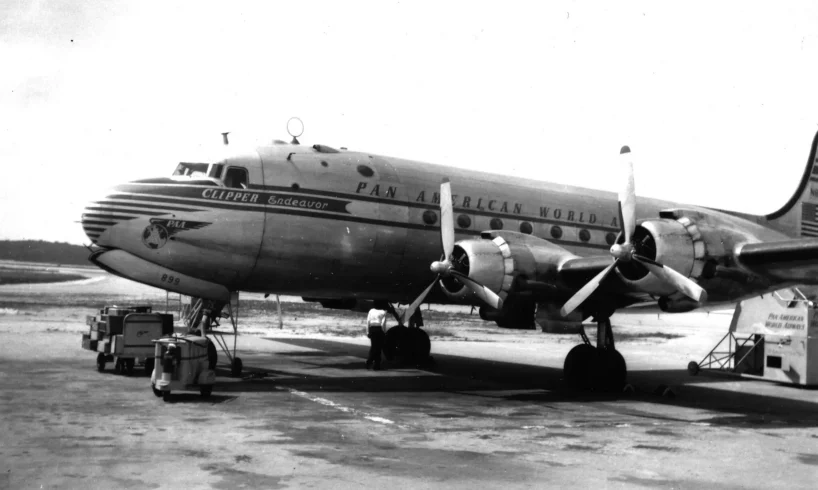
A poignant chapter in aviation history has been closed with the recent discovery of the wreckage of Pan Am's "Clipper Endeavor," a Douglas DC-4 aircraft that tragically crashed off the coast of Puerto Rico on April 11, 1952. The discovery, made on June 2, 2026, by a team of explorers from the Air/Sea Heritage Foundation and Deep Sea Vision, in collaboration with the Discovery Channel's "Expedition Unknown," brings a sense of closure to a mystery that had remained unsolved for 74 years. The wreckage was located approximately five miles off the northern coast of Puerto Rico, resting nearly 2,000 feet below the surface of the Atlantic Ocean. High-resolution sonar and subsequent photographic surveys confirmed the aircraft's identity, with parts of the iconic Pan Am logo and the name "Clipper Endeavor" still visible on the remarkably preserved fuselage.
The "Clipper Endeavor" was en route to New York from San Juan when it experienced a catastrophic failure, losing power in two of its four engines shortly after takeoff. This led to an emergency water landing, during which the aircraft's tail broke off. While all 64 passengers and five crew members initially survived the impact, the lack of pre-flight safety briefings, effective evacuation procedures, and adequate communication in the chaotic aftermath resulted in a devastating loss of life. Of the 69 souls on board, only 17 survived, with 52 people tragically losing their lives as the plane quickly sank. This event, known as "La Tragedia del Viernes Santo" (The Good Friday Tragedy), became a pivotal moment in aviation history.
The consequences of the "Clipper Endeavor" disaster were profound, directly leading to the implementation of mandatory pre-flight safety briefings and emergency procedure demonstrations that are now a standard on every commercial flight worldwide. Aviation safety experts emphasize that the lessons learned from this tragedy have contributed significantly to the high safety standards enjoyed by air travelers today. The discovery of the wreckage is seen not only as a means to understand the past but also as a testament to the advancements in technology that made such a deep-sea recovery possible.
The quest to find the "Clipper Endeavor" was reignited in 2019 when aviation and maritime historian Russ Matthews, president of the Air/Sea Heritage Foundation, began researching the crash after finding a luggage tag from the flight washed ashore in Florida. Years of diligent research, including the examination of archives from Pan Am, the Coast Guard, and the Civil Aeronautics Board, along with crucial information from Puerto Rican hearing records and a map created by eyewitness Air Force pilots, helped pinpoint the likely crash site. A previous attempt to locate the wreck in 2024 was hampered by bad weather.
The exploration team did not disturb the wreckage, respecting it as a grave site, and has no plans to recover any remains. They are currently working with the Puerto Rican government to establish protections for the wreck site and create a memorial for the victims. The story of this significant discovery and the history of the "Clipper Endeavor" will be featured in an upcoming episode of the Discovery Channel's "Expedition Unknown," offering a broader audience a chance to learn about this critical event in aviation history and the technology that finally brought its wreckage to light.