
There’s rarely an opportune time to shut down a runway, especially for busy commercial airports. But some closures are far more impactful than others.
The recent need to temporarily close Runway 13R-31L at San Antonio International Airport (SAT) for pavement rehabilitation had potential to severely disrupt operations there and at two nearby U.S. military installations that train the next generation of soldiers, airmen and pilots.
Facing intense time pressure to complete the improvements, SAT worked closely with project stakeholders to trim what could have been a six-month runway closure to less than eight weeks. The work budgeted at $25 million ended on March 5—one day early and nearly $2 million under budget. The airport’s top executive attributes those achievements in part to the FAA granting a rare approval for use of the construction manager at risk (CMAR) delivery method for an airfield project, which both streamlined and accelerated the work.
facts&figures
Project: Runway Rehabilitation
Location: San Antonio Int’l Airport, in TX
Runway: 13R-31L
Scope: Replaced nearly 180 concrete panels; added LED lighting & high-speed runway exits; improved airfield geometry, drainage & markings
Key Benefits: Restore condition of individual panels as needed to extend interval before full reconstruction; minimize disruption to commercial & military operations
Approx. Cost: $23 million
Funding: $17 million in Airport Improvement Program grants; $6 million from airport
Project Delivery Method: Construction Manager at Risk (CMAR)
CMAR Manager & Contractor: Austin Bridge & Road
Architectural Designers: Kimley-Horn (Prime); Jacobs (Electrical); Maestas (Surveying); Foster CM Group (Construction)
Safety Management System: Faith Group
Project Timeline: Design began June 2024; onsite work Jan. 12- March 5, 2026
Commercial Carriers Affected: Aeroméxico, Air Canada, Alaska, American, Breeze, Delta, Frontier, Southwest, Sun Country, United, Viva, Volaris
2025 Passenger Volume: 10.74 million
Jesus Saenz Jr., director of airports for the city of San Antonio, says all involved recognized what was at stake for SAT to be without the 8,502-foot “workhorse” runway that typically handles up to 90% of its daily operations. Minimizing the project’s impact on nearby U.S. Air Force activities was also an imperative, he adds.
“We judge success by aircraft taking off and aircraft landing,” Saenz says. “The second that stops, we’re not successful anymore.
“Working collaboratively through CMAR, from the design element through the construction work, was really beneficial to us.”
Pounding the Pavement
Following a 25-year tenure with the Houston Airports System, Saenz headed west across Texas to take the helm at SAT in February 2020. One of his first objectives as director was to hire Kimley-Horn to perform a comprehensive review of the airport’s three runways and adjacent taxiways.
Although 13R-31L is among the oldest active runways in the National Airspace System, a full replacement wasn’t called for right away. Pavement Condition Index findings indicated that only certain panels were nearing the end of useful service—a testament to ongoing maintenance and previous rehabilitation work during the last 85 years.
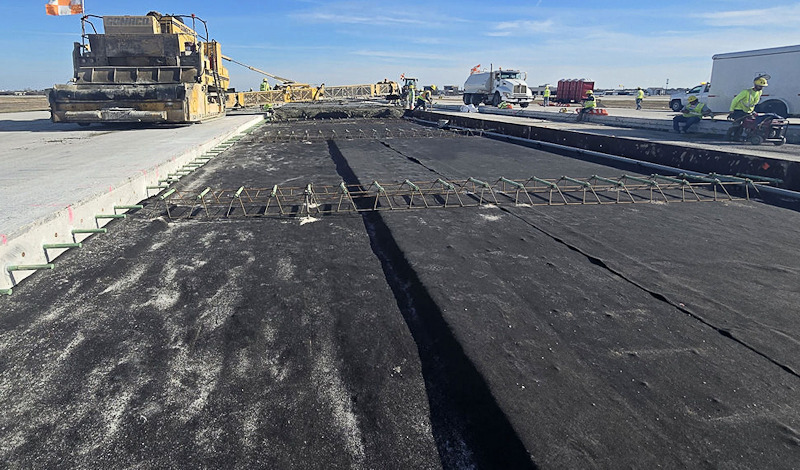
In addition to installing nearly 180 new concrete panels, the airport upgraded the runway’s electrical lighting systems to energy-efficient LED technology, improved pavement markings, and reconfigured or regraded select taxiway angles. New high-speed taxiways were also added to enable landing aircraft to safely clear the runway more quickly.
While the project was underway, all commercial activity was temporarily shifted to the 8,505-foot crosswind option, Runway 04-22. (At just 5,519 feet, SAT’s third runway—13L/31R—is reserved exclusively for general aviation.)
The FAA covered $17 million of the $23 million runway rehab through Airport Improvement Program grants. With these upgrades complete, Runway 13R-31L is now expected to last five to 10 more years before a full replacement is needed.
Airfield efficiency has taken on greater importance as work continues on ELEVATE/SAT, a $2.5 billion program that represents the largest capital improvement program in the city’s 308-year history. The centerpiece will be Terminal C, an 850,000-square-foot addition with 18 new gates scheduled to debut in mid-2028.
“As we look toward the opening of Terminal C, plus the movement and what’s happening at Terminals A and B…all of that was taken into consideration [for the recently completed runway rehabilitation],” Saenz says.
The overall objective is to create efficiencies in the terminals and airspace, and to improve alignments for aircraft ground movement, he explains.
Being located in “Military City USA,” SAT has a significant added challenge of balancing the civilian airspace demands of a tourism-heavy destination with the mission-readiness of Uncle Sam’s uniformed aviators. Airport leaders hope current efforts may someday lead to airfield configuration changes that increase operational flexibility for the airport and nearby military bases.
The FAA has undertaken an Environmental Impact Statement to evaluate the best uses of SAT’s airfield over the coming decades. Pending its findings, Saenz believes airfield capacity could grow from 100,000 annual operations today to 150,000 or more as future demand warrants.
Mission Critical
One glace at a map is all it takes to understand the complexities of the airspace around San Antonio, especially when SAT’s Runway 04-22 is used for commercial flights. Its northeast-by-southwest heading clearly conflicts with parallel Runways 15-33 at Randolph Air Force Base, and, to a lesser extent, Runway 16-34 at Lackland Air Force Base. Together with the Army’s Fort Sam Houston, Randolph and Lackland comprise the larger Joint Base San Antonio.
Located 17 miles due east of SAT, Randolph is home to the Air Force’s 12th Flying Training Wing, where U.S. and allied personnel study pilot instruction, electronic warfare and how to fly unmanned aircraft systems, among other assignments. Teaching such fighter fundamentals has earned Randolph the nickname “Source of America’s Airpower,” and its airfield logs up to 225,000 military operations annually.
Lights were upgraded to energy-efficient LEDs.
Separately, Lackland sits about 19 miles southwest of SAT. It is home to the 433rd Airlift Wing that flies massive C-5M Super Galaxy heavy strategic transports, as well as a squadron of F-16 jets assigned to the Texas Air National Guard’s 149th Fighter Wing. In addition, Lackland’s 37th Training Wing handles basic training for nearly 80,000 Air Force recruits each year, a majority of whom fly through the region via commercial flights at SAT.
“Joint Base San Antonio is a mission-critical facility,” emphasizes Edwin Tamang, a San Antonio-based vice president at Kimley-Horn, the master planner of SAT’s airfield projects. “Given the economic influence of the military, having to displace flights is never a good thing,”
When it came time to plan the work on Runway 13R-31L, SAT’s team applied lessons learned from a temporary runway closure more than a decade ago and began collaborating with Air Force leaders a full year before the runway would close in early 2026. Those conversations included FAA representatives from headquarters in Washington, D.C., as well as the Southwest Regional Office/Central Service Center in Fort Worth.
Air Force training operations were subsequently adjusted to occur outside SAT’s scheduled runway closure from Jan. 12 to March 6. This meant more sorties occurred before the military’s annual Holiday Block Leave or later in March. The goal, Tamang explains, was to find a workable schedule that “minimized pain points for all.”
One unexpected change resulting from preliminary discussions was shrinking the rehabilitation plan’s original scope to decrease the closure time. Tamang credits Matthew Tamrowski, a project manager at Austin Bridge & Road, and Kimley-Horn Vice President and Project Engineer David Sparkes for their willingness to listen and work to balance everyone’s needs.
“You don’t often have a contractor that’s willing to suggest reducing the scope to make up time,” Tamang remarks. “But we were always talking, [discussing ideas] to surgically tweak the phasing for every key stakeholder—including the military— in order to get this going.”
And while no one knew so before the project was planned, the early March conclusion of SAT-prompted restrictions on Joint Base San Antonio meshed perfectly with heightened military activity stemming from the Feb. 28 start of the United States’ war with Iran.
“It’s no easy task,” Saenz says. “Having the right people in the room to make decisions; a true collaborative spirit as it relates to design and the work to be performed; and then being able to execute on that from a construction standpoint— that’s what gets us what [successes] we’re getting.”
Alternative Delivery Method Paves the Way
Still, as 20th century French aviator Antoine de Saint-Exupéry once surmised, “A goal without a plan is just a wish.”
From early on, SAT’s team knew a conventional construction approach—design, bid, build—would not meet its needs, nor those of its military neighbors. That’s why Saenz, Tamang and others sought FAA’s permission to use the CMAR delivery method.
Under CMAR, a project owner hires one firm to design a project, then negotiates a separate concurrent contract with a construction manager-at-risk, or CMAR, to perform tasks associated with construction. These parties are contractually bound to work together from the design phase onward, and to establish a maximum guaranteed price for the work.
When executed effectively, CMAR can mitigate cost risks and abbreviate construction timelines.
For Runway 13R-31L, SAT selected Kimley-Horn as lead designer with assistance from Jacobs (electrical), Maestas (surveying) and Foster CM Group (construction design). Austin Bridge & Road was hired as the CMAR agent, handling tasks such as scheduling, procurement packages and scope of work planning.
Austin Bridge & Road, a leader in the heavy highway and transportation infrastructure industry for more than 100 years, was later selected under a separate bid process to serve as the airport’s primary contractor, a variation of CMAR delivery known as Construction Manager/General Contractor, or CM/GC.
Brian Salerno, president of Austin Bridge & Road, notes that CMAR has long been widely adopted for vertical airport projects, such as terminal and other structures, but it remains far less common for horizontal surface work and other civil projects at airports.
That’s beginning to change, though. Six years ago, Arizona’s Tucson International Airport (TUS) built its new 10,996-foot commercial Runway 12R-30L using CMAR. Further north in greater Phoenix, Mesa Gateway Airport (AZA) likewise used the method late last year when rebuilding 2,800 feet of pavement for its Runway 12R-30L.
More recently, Colorado’s Aspen/Pitkin County Airport (ASE) announced in August it would use CMAR for a runway reconstruction and relocation project beginning in spring 2027.
Salerno posits that FAA’s historic reluctance to allow use of the CMAR structure on surface projects stems from unease over delivery timing. It’s one thing for a building to miss its scheduled opening date, but a delayed runway opening can be far more impactful to the overall airspace system.
Those concerns were eased by his company’s work history. Since the 1970s, Austin has developed more than 140 aviation projects at 25 airports including Chicago O’Hare (ORD), San Francisco International (SFO) and Newark Liberty International (EWR). It also has extensive runway experience from work completed at Dallas-Fort Worth International (DFW), just a stone’s throw from the firm’s headquarters in Coppell, TX.
“We’re very strong on our airfield resume. So that, combined with the [off-airport] CMAR experience within our organization, allowed us to win Austin-Bergstrom,” Salerno explains, referring to the CMAR contract Austin Bridge & Road won for a midfield taxiway project at AUS just months before it bid on the CMAR runway project at SAT.
Contractors installed nearly 180 new concrete panels.
The military’s tight timeframe also contributed to FAA’s willingness to consider CMAR, adds Tamang. Austin Bridge & Road began working with Kimley-Horn in September 2025.
Looking ahead, both teams will shift focus to developing an airfield drainage system for SAT that is scheduled to begin construction in 2027. That project will add a nearly mile-long, 8-foot-diameter drainpipe beneath two active runways and new drainage structures. It will include more runway rehabilitation and begin earthwork to set the stage for a full replacement of Runway 13R-31L a few years from now.
Jigsaw Coming Together
Kimley-Horn’s Tamang says he loves nothing more than to “geek out” over the nuances of civil engineering. SAT’s runway afforded him plenty of opportunities given its lengthy history.
“That runway was built in four different phases over time,” he explains. “You have World War II-era, then Jet Age and commercial extensions. The composition of the runway has so much variety to it.”
Modern runways typically have Portland Cement Concrete set at a singular thickness, usually ranging from 18 to 20 inches deep. Runway 13R-31L had portions where the initial concrete thickness was just 6.5 inches, with subsequent pours anywhere from 12 to 21 inches tall—and in varying widths.
“Is that best practice in 2026?” Tamang asks in jest. “No.”
FAA normally eschews repaving over variable thicknesses because doing so can result in uneven surfaces that become noticeable to pilots and passengers alike. But Tamang says federal engineers also recognized SAT couldn’t afford to shut down its runway for too long given the stresses that would have created for commercial airlines and the military.
Some of the removed panels will be crushed and used as fill material for other projects.
“(The Southwest Region Airport District Office) said, ‘We’re going to be OK with you doing this kind of paving as long as your contractor can do it,’” he relates.
Austin Bridge & Road also had the foresight to save some of the former panels from Runway 13R-31L to reuse as crushable fill material for later airfield work.
“You had guys who were really thinking long-term to say, ‘Let’s do this and do this right.’ It allowed for the right amount of back and forth,” Tamang remarks.
In the end, Saenz was pleased to be able to tell SAT’s commercial carriers and the military brass that the airport and its project team had collaborated to enable air traffic to run at maximum efficiency. “Airlines often tell me they don’t make money with airplanes sitting on the ground,” he says. “They want them up in the air. And that’s our job at airports—to ensure we minimize delays and maximize their on-time performance.”
For Salerno, the recent runway rehabilitation at SAT will help demonstrate that alternative delivery methods such as CMAR can be applied to airfield jobs. “We had confidence we could execute and beat the schedule,” he says. “Because this has been successful, airport owners are now able to talk about [airfield CMAR] as a more optimal way of delivering projects in the future, which I think is good for the industry.”