

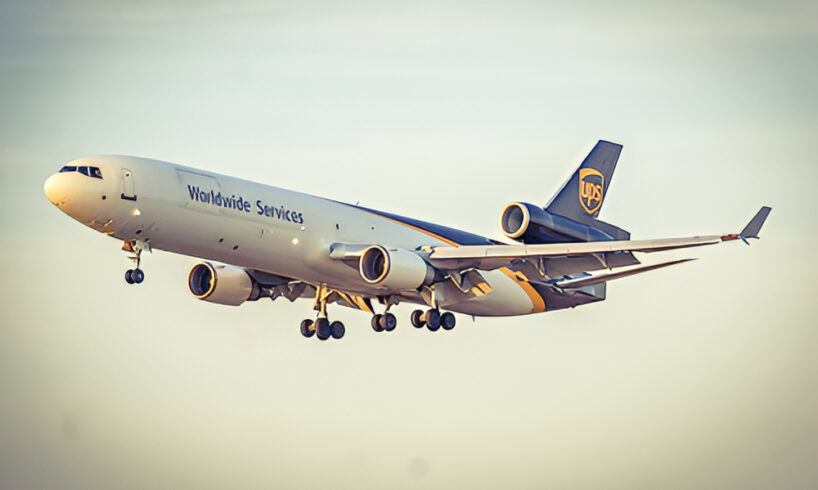
The National Transportation Safety Board (NTSB) has provided an updated investigative report on the devastating crash of UPS Flight 2976, which occurred on November 4, 2025. The incident, which took place shortly after takeoff from Louisville Muhammad Ali International Airport (SDF), resulted in the loss of the aircraft and tragically claimed the lives of the three crew members on board, as well as eleven individuals on the ground. An additional twenty-three people on the ground sustained injuries.
The preliminary findings indicate that the left engine and its pylon separated from the aircraft during takeoff. Surveillance videos captured the moment the engine detached, followed by a subsequent fire near the engine and the wing attachment area. The NTSB’s investigation has identified metal fatigue as a significant factor, with cracks found in the left engine pylon. Specifically, fatigue cracks were observed on both fracture surfaces of the aft mount’s aft lug, and along the bore of the aft mount forward lug’s inboard fracture surface.
In response to the accident, the NTSB initiated a thorough investigation, with teams documenting the accident site and collecting crucial data. Parties participating in the investigation include the Federal Aviation Administration (FAA), UPS, The Boeing Company, the Independent Pilots Association (IPA), GE Aerospace, and the Teamsters Airline Division, among others. The NTSB has released an investigative update on January 14, 2026, and has made the preliminary report available to the public.
The crash has striking similarities to the 1979 American Airlines Flight 191 accident, which also involved a DC-10 with comparable engine mounting structures. This has raised questions about the design and maintenance protocols for such components. In the wake of the incident, UPS has announced the accelerated retirement of its entire MD-11F fleet, replacing these aircraft with more efficient Boeing 767 freighters.
The NTSB continues its work to determine the probable cause of the accident and will issue safety recommendations to prevent similar tragedies in the future. The ongoing investigation will delve deeper into the maintenance history of the aircraft and the specific failure mechanisms of the engine pylon to provide a comprehensive understanding of the events that led to this catastrophic loss.