
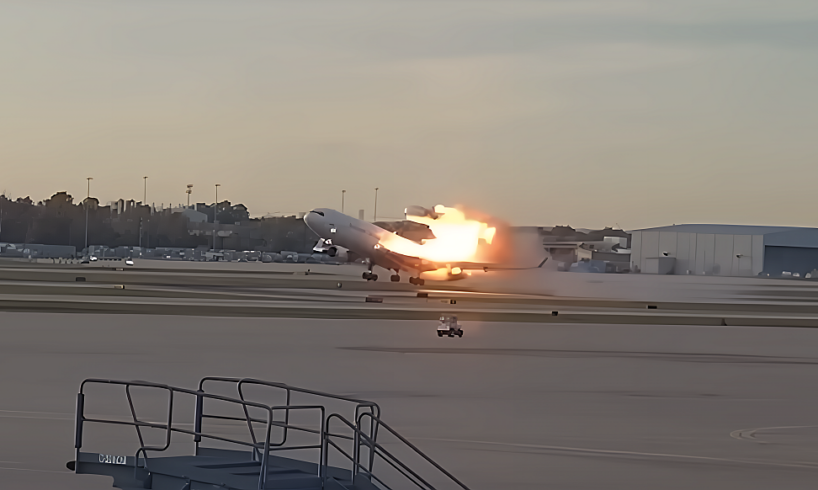
WASHINGTON D.C. – A two-day National Transportation Safety Board (NTSB) hearing concluded this week, shedding light on the circumstances surrounding the fatal November 4, 2025, crash of UPS Flight 2976, a Boeing MD-11F cargo aircraft. The crash, which claimed the lives of 15 people, occurred when the aircraft's left engine and pylon separated during takeoff from Muhammad Ali International Airport in Louisville, Kentucky. Investigators revealed that both Boeing and the Federal Aviation Administration (FAA) were aware of cracking risks associated with a critical aft pylon bearing component for years prior to the incident.
The NTSB hearing disclosed that despite at least 10 documented instances of aft pylon bearing failures between 2002 and 2022, and Boeing's own 2007 Safety Review Board conclusion that such failures could lead to aft pylon lug damage, Boeing management did not classify the issue as a safety concern. This inaction has drawn criticism, with suggestions that potential monetary costs associated with re-certification might have influenced Boeing's decision-making. The hearing also revealed that while replacement of the part was recommended, it was not mandated by regulators.
During the second day of the hearings, Boeing representatives acknowledged that the failed aft pylon spherical bearing should have been designated as a Principal Structural Element (PSE) during the MD-11's original FAA certification process decades ago. This classification would have necessitated more stringent inspections and maintenance protocols. Boeing further admitted that its subsequent Continuing Operational Safety program failed to identify the deficiency and the potential for catastrophic failure resulting from an aft pylon bearing issue. The FAA also conceded that it did not identify this critical deficiency, with an FAA engineer noting that knowledge of the potential severity of bearing failure could have altered the safety determination made years ago.
The investigation detailed how fatigue fractures within the spherical bearing altered the structural load path, leading to the failure of both aft pylon lugs during takeoff. This catastrophic separation resulted in the engine shooting upwards and away from the aircraft. The NTSB's preliminary report had indicated mechanical problems involving fatigue fractures with the aircraft's left pylon. Prior to the crash, the flight crew had switched to the aircraft involved in the accident due to a fuel leak in the originally assigned plane.
The NTSB hearing also highlighted issues with the reporting and analysis of structural anomalies. It was noted that out of nine prior reports of similar pylon bearing failures on other MD-11 aircraft, only four were formally reported to regulators, and seven were reported to Boeing. This lack of consistent reporting and trend analysis made it difficult to identify systemic issues. Following the crash, the FAA temporarily grounded MD-11, DC-10, and MD-10 aircraft, prompting UPS to retire its MD-11 fleet. FedEx, however, is retrofitting its MD-11 fleet with new aft pylon bulkheads and spherical bearings. The NTSB anticipates releasing its final investigative report approximately one year after the crash.