
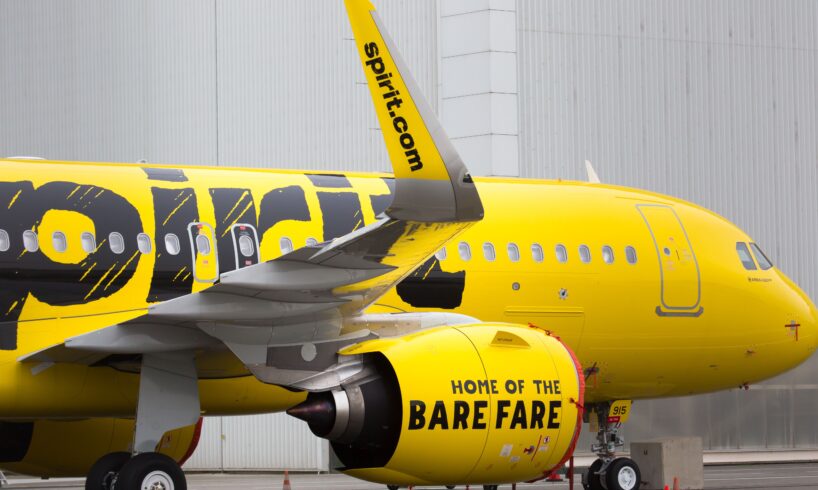
Spirit Airlines has been forced to take several Airbus A320 family aircraft out of service after the fire suppression system was inadvertently activated at its maintenance hangar in Detroit. The incident, which resulted in a lot of foam being discharged inside the hangar that later spilled onto the apron near the building, happened on July 4.
According to the carrier, it is believed that nearby lightning caused the discharge of foam. Spirit Airlines has worked with a contractor to clean up the foam that is inside and outside the aircraft hangar, with no significant impact on its flight operations.
Spirit Airlines’ Foam Incident In Detroit
Photo: Daniel J. Macy | Shutterstock
On July 4, the fire suppression system inside Spirit Airlines’ maintenance hangar at Detroit Metropolitan Wayne County Airport (DTW) discharged foam. Pictures and videos, shared on social media, showed at least two aircraft inside the hangar and four outside of it at the time of the incident.
In a statement to View from the Wing, Spirit Airlines confirmed the incident, saying that the fire suppression system was “inadvertently activated.” The airline believed that the system discharged foam due to nearby lightning, adding that there was no fire inside the hangar and nobody suffered any injuries during the event.
“We have engaged a contractor to assist with cleanup efforts, and we thank first responders for their quick response and assistance. There is no impact to our flight operations.”
Removing Aircraft Affected By Foam From Service
Photo: YES Market Media | Shutterstock
The airline’s spokesperson confirmed to the site that it had removed two aircraft that were inside the hangar and one that was outside the facility from commercial service. According to ch-aviation records, Spirit Airlines has 14 A320 family aircraft, including the A320ceo, A320neo, A321ceo, and A321neo, based at the airport in Michigan.
Out of the 14, four A320ceos, namely N907NK, N912NK, N918NK, and N925NK, are currently at Phoenix Goodyear Airport (GYR). The quartet was not involved in the sale of 23 A320ceo family aircraft to GA Telesis, a United States-based asset manager, which was announced in October 2024.
In addition to the three aircraft that Spirit Airlines has taken out of service due to the foam incident in Detroit, the low-cost carrier has been forced to park as many as 58 aircraft, including 37 A320neos. Some of the latter have been stored due to ongoing accelerated removals and inspections of the type’s Pratt & Whitney PW1100G engines that began in 2023 after RTX, the parent company of Pratt & Whitney, disclosed a rare condition in powder metal used to make specific parts of the engine, known as the Geared Turbofan (GTF), built between Q4 2015 and Q3 2021.
Related
Spirit Airlines Extends Deal With Pratt & Whitney To Cover Airbus A320neo Groundings
Spirit Airlines currently has 36 out of 91 Airbus A320neo aircraft grounded.
Foam Discharges At Other Facilities
Photo: United States Air Force | Airman 1st Class Chris Jacobs
Over the past few years, there have been other inadvertent foam discharges in hangars across airlines’ maintenance facilities. On February 1, 2024, Houston George Bush Intercontinental Airport (IAH) confirmed that at around 5:30 am local time (UTC -6), fire suppression foam was released inside a United Airlines building.
However, at the time, there were no people or aircraft inside the hangar, resulting in no impact on the airline’s or the airport’s operations. In March 2020, Delta Air Lines suffered a similar incident at Los Angeles International Airport (LAX), with the carrier confirming that its hangar’s fire suppression system malfunctioned, causing foam to be dispersed inside the facility.
In 2014, the inadvertent discharge of foam at Eglin Air Force Base (VPS) resulted in a single fatality. A follow-up report by the Air Force Test Center (AFTC) determined that the primary cause of the incident was “a valve failure due to freezing water inside the pipes during historically low temperatures” between January 6, 2014, and January 8, 2014, with the report noting that the combination of freezing temperatures followed by a quick thaw resulted in burst pipes and leaks. “The main reason for the fatality and injuries suffered as a result of the mishap was the loss of situational awareness and decisions made by the contractors to use the building elevator from the third floor to the first floor while the incident was ongoing,” the report added.
Year Founded
1983
CEO
Ted Christie